
Māori

INTRODUCTION
Maori are the native people in New Zealand. They are a tribe that rich with culture and powerful social organization. With the arrivals of European in the 17th century, this indigenous society gradually adopt the life of the Westerners since the Treaty of Waitangi was formed in 1840 as a part of new British colony. Since then, the Maori people cross tension with the Europeans or Pakeha ( Maori language ) with the wars, lands claim and other major conflicts. This was the factor of the decline of this society in New Zealand in that period of time.
But after that in the 20th century, the Maori people began to rise and therefore increase their population in the New Zealand society. They started to learn the culture of other races and also accepts technologies that were brought to New Zealand in order to help them expand and educate themselves in this growing world. This much needed effort will help them to compete with the others in many aspects such as economy, cultures and education whether it is inside or outside New Zealand (Wikipedia, n.d)
TECHNOLOGY IMPACTS
Historically, Maori people are like the other culture where most of the society uses stone, wood and the forests for their daily needs. Maori people are mostly horticulture and also rely their foods on the seas where it is easy for them as their main mode of transport is canoe. But with the arrival of Europeans, their traditional technology seems to be fading with the Europeans introduce the technologies that a lot more advanced such as new mode of transport, literacy and importantly musket. This seems to make they rage over the Europeans and typically wars become the answer for them. The decline for the Maori have been significantly happen in the wars where they lost the lands to the Europeans and they can't fight with the firepower that Europeans had. This however, turns as most of the Maori trade for firepower and musket to give them sense of security and also to defend their land from other tribes. (Tapsell, 2009)
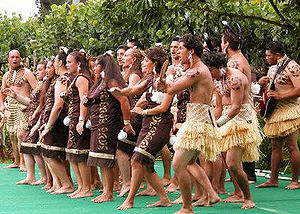
In the sense of culture, technology have also impacted this native society of New Zealand. Apparently, until today most of the Maori culture is preserved to keep their beliefs and customs. One of the Maori culture pride, that is Marae is still being build throughout the country. The design and traditional value were still kept until today but the materials and the construction are based from today technologies to help the Marae strong and a place where everyone can benefits from it. (Taylor, n.d. para. 7). Besides that, the schooling system in New Zealand follows the British way. But to help the culture remain strong, the Maori-language education were introduced to help educate young Maori to never forget their roots. Furthermore, most of Maori art nowadays adapt western techniques to provide a contemporary and creative ways to shows the Maori culture to the world. (Royal, 2009).
Socially, the Maori have adapt well of the technology to use it to interact with others in the society. The use of technology have created the urbanisation effect to them. Most Maori leaves their tribal and rural home and stays in the cities thus, creating an urban Maori communities. This community get better education in the westerners institutions and jobs. Now in the 21st century with Maori being educated, the society of New Zealand now approves the Maori as an influential force. More and more Maori people being successful in today news and more companies and media being associated and owned by Maori themselves. (Royal, 2009)

COMPARISONS
With Maori being influential in New Zealand, Orang Asli in Malaysia were still left out in the context of lifestyles, technology acceptance and also society views. Orang Asli were classified as the aboriginals in Malaysia and the concern for them came after the development of Malaysia approach along their lands. Until today, Orang Asli still searching for their identities and lands in the fast developing Malaysia land.
One of the issue regarding Orang Asli is that education are one of the concern. A research by Suhakam, a human rights commision in Malaysia shows that nearly 7000 of Orang Asli children never attended school. The factors are that they exceptionally lives deep inside the jungle and transportation also become one of the issue. This somehow affects the Orang Asli society where education is needed to get the children to face up the world in the future. This surely hurts the reputation of them eventhough by being the indigenous people of Malaysia. (MySinchew, 2012).
Besides that, with the old traditional system that Orang Asli still practise up until today make them pay as they lost up most of their lands to developers to make way for logging, plantation and modern development. This is because there are no standard procedure for them from the government to claim their lands like normal citizen with land title or grant. This will cause the Orang Asli to decline much more further in the land of Malaysia. (Jayasooria, 2012)
Because of all this factors, the concern from public and non government organisation turns out to help the Orang Asli. This is mainly to protect their rights as the indigenous people of Malaysia and to help them develop their community in Malaysia while suppress the Malaysian government to take actions on it. One of the issues are education where it could help to lift the Orang Asli out from poverty and also providing more subtle land and houses to them. This effort is in conjunction to help them from becoming extinct in Malaysian book of history. (Shukry, 2012)

REFERENCE LIST
Jayasooria, (2012, May 29) Orang Asli struggle for land and identity. The Malay Mail. Retrieved from http://www.mmail.com.my/story/orang-asli-struggle-land-and-identity
MySinchew. (2012, September 3) 7,000 Orang Asli children have never attended school. MySinChew.com. Retrieved from http://www.mysinchew.com/node/77214
Shukry, A. (2012, November 7) Govt failed to protect Orang Asli rights. Retrieved from http://www.freemalaysiatoday.com/category/nation/2012/11/07/govt-failed-to-protect-orang-asli-rights/
Royal, C. (2009, March 3). 'Māori - Urbanisation and renaissance', Te Ara - the Encyclopedia of New Zealand. Retrieved from http://www.teara.govt.nz/en/maori/5
Tapsell, P. (2009, March 4). 'Te Arawa - European impact, Te Ara - the Encyclopedia of New Zealand. Retrieved from http://www.teara.govt.nz/en/te-arawa/4
Taylor, E. (n.d) 'Korero'. National Library of New Zealand. Retrieved from http://teaohou.natlib.govt.nz/journals/teaohou/issue/Mao02TeA/c14.html
Wikipedia, (n.d) Maori people. Retrieved from http://en.wikipedia.org/wiki/M%C4%81ori_people

No comments:
Post a Comment